Reasons Why Children’s Teeth Shift
The Natural Pressure of Eruption
Your child’s mouth is a dynamic space. Baby teeth hold position through constant, gentle pressure. Remove a baby tooth, and that pressure equation changes immediately. The teeth on either side of the gap have nothing pushing back against them anymore. Chewing forces from above create pressure that tilts them inward. The teeth behind the gap drift forward.
This isn’t a slow process that happens over years. Teeth can shift noticeably within weeks of losing a baby tooth. The longer the gap exists without a space maintainer, the more the surrounding teeth migrate.
When Gaps Are Most Dangerous
Early loss of baby teeth creates the biggest problems. If your child loses a baby molar at age 5 or 6, the permanent molar won’t erupt for another 5 or 6 years. That’s a long time for surrounding teeth to shift and take over the space.
Losing a baby tooth close to when the permanent tooth is ready to erupt is less problematic. If your child loses a baby canine at age 7 when the permanent canine is already beginning to erupt, the permanent tooth might push into place naturally without much shifting of adjacent teeth.
Dr. Matt assesses your child’s specific situation. He considers which tooth was lost, how old your child is, and when the permanent tooth is likely to erupt. This determines whether a space maintainer is necessary.
Types of Space Maintainers
Fixed Space Maintainers
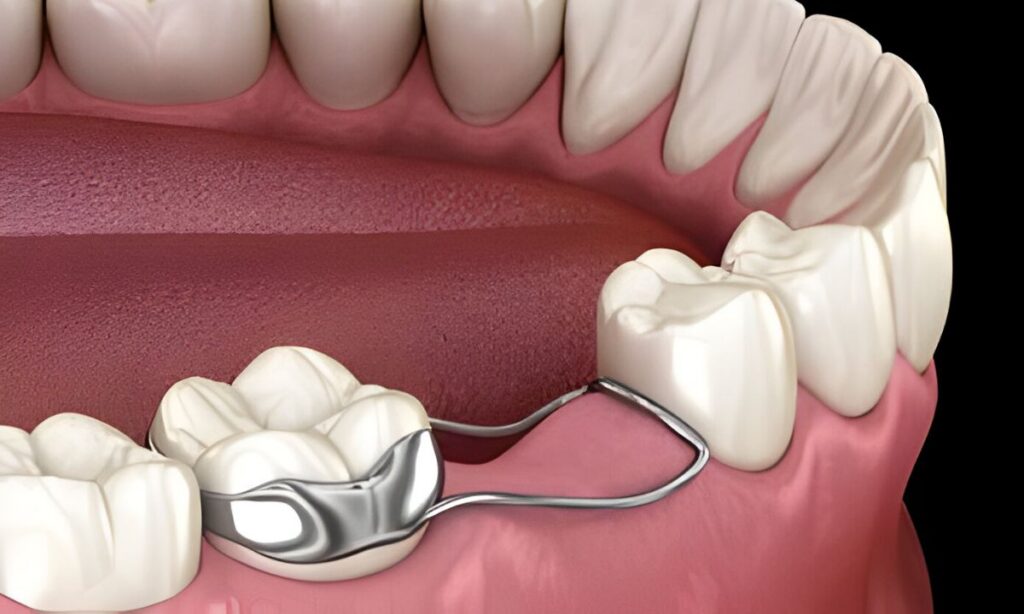
Fixed space maintainers are bonded permanently to teeth and cannot be removed by your child. They consist of a band that goes around one tooth and a wire or arm that extends across the gap to the tooth on the other side.
Fixed maintainers are highly effective because they cannot be lost, forgotten, or accidentally broken by your child. They work 24/7 without any effort required. Your child brushes and flosses normally around them. They stay in place until Dr. Matt removes them when the permanent tooth is ready to erupt.
Fixed maintainers are ideal for:
- Children who are prone to losing things
- Younger children who might forget to wear a removable device
- Children who have difficulty with cooperation around oral appliances
- Situations where maximum effectiveness is critical
Removable Space Maintainers
Removable space maintainers look similar to a retainer. They’re made of acrylic and wire and fit into your child’s mouth. Your child wears them when eating and sleeping, then removes them for school, sports, or social events.
Removable maintainers offer benefits for certain situations:
- More flexibility in social situations
- Easier to clean since your child can remove them for brushing and flossing
- Less visible when removed
- Can be adjusted or remade if your child’s mouth grows
However, removable maintainers require responsibility and consistency. Your child must remember to wear them. They must put them in safely without breaking them. They must clean them properly. For younger children or those with less developed responsibility, this is challenging.
Comparison of Options
| Factor |
Fixed |
Removable |
| Visibility |
Visible with close inspection |
Less visible when removed |
| Reliability |
Works automatically 24/7 |
Depends on child compliance |
| Cleaning |
Requires careful technique |
Easier, can remove for cleaning |
| Cost |
Varies by complexity |
Typically less expensive |
| Best For |
Most children, especially younger ones |
Mature children who are responsible |
Dr. Matt recommends the type of space maintainer that will work best for your child’s specific situation, considering their age, responsibility level, and which tooth was lost.
Who Needs a Space Maintainer?
Early loss of baby molars typically requires a space maintainer. If your child loses a baby molar before the permanent molar is ready to erupt (usually several years early), a space maintainer prevents surrounding teeth from shifting into the gap. Baby molars hold significant space, and loss of these teeth leads to crowding problems that affect multiple teeth.
When your child loses several baby teeth early, either due to extraction or trauma, the risk of crowding increases substantially. Multiple gaps create complex shifting patterns. Space maintainers become especially important in these situations.
Risk Factors That Increase Your Child’s Need for a Space Maintainer
- Naturally crowded baby teeth to begin with
- Family history of orthodontic treatment needs
- Parent or sibling with braces
- Genetic predisposition to crowding or jaw size issues
- Early tooth loss due to decay, trauma, or extraction
- Active sports participation that could cause tooth loss
- Multiple missing or lost baby teeth
Some children have naturally crowded baby teeth to begin with. These children are at higher risk of developing serious crowding with their permanent teeth. Early loss of baby teeth compounds this problem. Space maintainers help mitigate the damage.
Situations Where Space Maintainers Aren’t Needed
Not every baby tooth loss requires a space maintainer. If your child loses a baby tooth close to when the permanent tooth is ready to erupt, the permanent tooth may naturally push into place without significant shifting of adjacent teeth. For canines and incisors that are erupting soon, a space maintainer might not be necessary.
Dr. Matt takes X-rays to see how the permanent teeth are developing and when they’re likely to erupt. This helps him determine whether your child actually needs a space maintainer or whether the natural eruption process will resolve the space issue on its own.
The Space Maintainer Placement Process
Assessment and X-rays come first. Before recommending a space maintainer, Dr. Matt takes digital X-rays to see the developing permanent tooth and estimate when it will erupt. He examines your child’s mouth to assess the risk of tooth shifting and determine which type of space maintainer would work best.
This assessment is crucial. A space maintainer that’s not needed is a waste of time and money. A space maintainer that should be placed but isn’t can result in crowding that requires years of orthodontic treatment later.
Custom Fitting and Placement
If a fixed space maintainer is recommended, Dr. Matt takes precise measurements and impressions of your child’s teeth. The maintainer is custom-fabricated to fit your child’s specific anatomy. It’s bonded securely to the anchor tooth and cannot shift or loosen.
For a removable maintainer, your child comes in for a fitting appointment where the device is adjusted to fit comfortably and securely. Dr. Matt explains how to care for the space maintainer. For fixed maintainers, this involves careful brushing and flossing around the device. For removable maintainers, this includes proper cleaning, storage, and wearing schedule.
Follow-up Monitoring
Your child returns for periodic checkups, typically every six months. Dr. Matt monitors whether the space maintainer is functioning properly and whether the permanent tooth is developing as expected. As the permanent tooth gets closer to erupting, Dr. Matt monitors the process and removes the space maintainer at the appropriate time.
Caring For Your Child’s Space Maintainers
Daily Maintenance for Fixed Devices
- Brush carefully around the fixed space maintainer using a soft-bristled toothbrush
- The maintainer creates a small crevice where food and plaque can accumulate, requiring extra attention to this area
- Use a water flosser or special floss threader to clean underneath the wire
- Regular brushing and flossing prevent decay around the maintainer
- Avoid using the space maintainer as a place to push with the tongue
Care for Removable Devices
- When your child removes the maintainer, rinse it under running water to remove food debris
- Soak it daily in a denture cleaner or special maintainer cleaning solution
- Never use hot water, which can warp the acrylic
- Store it in a protective case when not wearing
- Avoid leaving it on tables, in pockets, or anywhere it might get lost or stepped on
- Check regularly that it fits properly as your child’s mouth grows
What to Avoid
Hard, sticky, or crunchy foods can damage space maintainers. Advise your child to avoid chewing on the device itself, playing with it with their tongue, or bending the wire. Contact sports should be played with a mouth guard to protect both the maintainer and the underlying teeth.
Bring your child for checkup appointments as scheduled. Dr. Matt verifies that the space maintainer is intact and functioning properly. He checks that no decay has developed around a fixed maintainer and that the permanent tooth is developing normally.
The Real Cost of Skipping a Space Maintainer
A space maintainer costs several hundred dollars and lasts for a few years until the permanent tooth erupts. Orthodontic treatment to correct crowding caused by premature tooth loss costs thousands of dollars and takes two to three years.
Think about the actual expense. Braces for two years costs $3,000 to $7,000 depending on the complexity. Monthly appointments. Adjustments. Retainers afterward. Potential need for tooth extraction if crowding is severe. Now multiply this by the number of your child’s siblings if they face similar problems.
A space maintainer is preventive. It stops the problem before it starts. The cost difference is substantial. Crowded teeth affect more than appearance. They’re harder to keep clean. Teeth that overlap trap food and plaque. Decay and gum disease become more likely. Crowded teeth can affect bite and jaw development, leading to long-term problems with chewing and speech.
Space maintainers prevent these cascading problems. They preserve the natural eruption path for permanent teeth and support your child’s oral development.
Space Maintainers Across Arnold and South County
Families in Arnold, Oakville, Mehlville, Affton, Festus, Imperial, and surrounding South County communities understand preventive dentistry. They know that stopping problems before they start is far better than dealing with them later.
What Arnold Families Value
Arnold parents in this established South County community appreciate that Dr. Matt doesn’t just treat problems after they develop. He anticipates where problems might occur and intervenes early. For children who have lost baby teeth early, space maintainers represent smart preventive care that saves time, money, and the stress of extensive orthodontic treatment.
Serving Your South County Neighborhood
Whether your family attends schools in the Mehlville School District like families in Oakville and Mehlville do, or lives in Affton where quality preventive care is valued, or in Festus near the scenic areas, we’re here to provide the preventive care that protects your child’s developing smile. Parents throughout South County appreciate that we offer:
- Proactive assessment rather than reactive treatment
- Clear explanation of whether space maintainers are actually needed
- Custom solutions tailored to each child’s situation
- Convenient location at 22 Arnold Mall accessible from all South County neighborhoods
- Integration with comprehensive preventive care planning
Whether your family is in Imperial, Herculaneum, or anywhere else in South County, space maintainers are one tool in our comprehensive approach to supporting your child’s oral health from childhood through the teenage years.
Schedule Your Child’s Space Maintainer Consultation
Space maintainers represent smart, preventive dentistry. They address a problem before it develops and prevent years of complications. For children who have lost baby teeth early, a space maintainer is one of the most cost-effective interventions we can recommend.
Dr. Matt assesses each child individually to determine whether a space maintainer is appropriate. He doesn’t recommend unnecessary devices, but when he does recommend one, it’s because he genuinely believes it will prevent crowding and protect your child’s developing smile.
If your child has lost a baby tooth early or if you’re concerned about potential crowding, contact us for an evaluation.
Pediatric Dentistry of Arnold
22 Arnold Mall Arnold, MO 63010
(314) 230-8615
We serve families throughout Arnold, Oakville, Mehlville, Affton, Festus, Imperial, and all of South County. Dr. Matt will assess whether your child needs a space maintainer and recommend the type that will work best for your family’s situation.